
Service
Digital Engineering
We modernise, build, integrate and scale the secure digital platforms and enterprise applications your business runs on — aligned to evolving customer expectations and to the systems you already operate.

We modernise, build, integrate and scale the secure digital platforms and enterprise applications your business runs on — aligned to evolving customer expectations and to the systems you already operate.
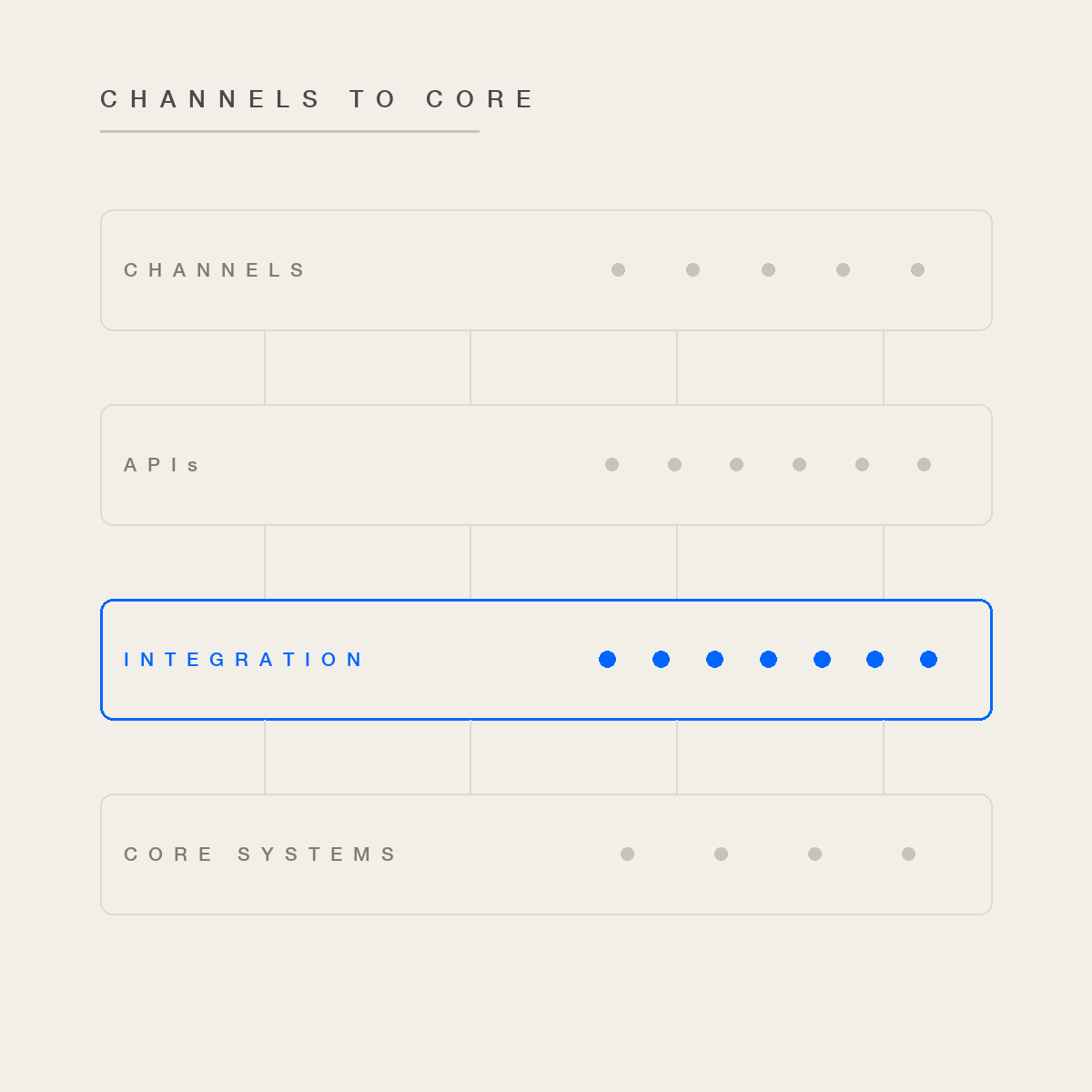
We modernise, build and integrate the systems a bank or enterprise runs on. That spans new digital products, the modernisation of applications that have carried the business for a decade, and the integration layer that quietly determines whether either of them works.
Most of this practice's work sits inside banks. We run multiple concurrent engagements alongside IBM and directly with leading banks across the Kingdom and the wider GCC, covering the functions a bank actually operates — digital channels, payments and file exchange, core integration, onboarding and servicing journeys, and the back-office systems those depend on.
That work is as much about delivery discipline as engineering. We provide project and programme management on these engagements: planning against the bank's own change calendar and release windows, coordinating across vendors who each own part of the estate, managing dependencies and regulatory deadlines, and keeping status reporting honest enough that problems surface while they are still cheap to fix.
Integration is rarely discussed until it breaks. It is where core banking meets digital channels, where partner and payment files arrive and settle, and where every API either enforces policy or quietly bypasses it.
IOTA Technologies is a signed IBM Business Partner. Within Digital Engineering we advise on and supply the IBM portfolio as well as implement it, with deep specialisation in enterprise integration.
API-led and event-driven integration connecting core banking, digital channels and SaaS — flow design, testing and CI/CD for integration artefacts, and migration from legacy integration nodes onto App Connect Enterprise.
The security gateway at your edge: API gateway and protocol bridging, message-level security, threat protection, TLS and mTLS termination and policy enforcement — appliance, virtual or containerised, sized for regulated workloads.
Partner and file exchange: B2B and EDI onboarding, managed file transfer, host-to-host and payment file flows, partner self-service and operational visibility across the exchange estate.
Service mediation and modernisation — routing and transformation, and migration from legacy ESB estates onto modern runtimes without disrupting downstream consumers.
Banks run on documents — onboarding packs, trade and payment files, statements, contracts and the correspondence around them. Most of that content is still moved by people, because the systems around it can store a file without understanding what is inside it.
We address that with Nutrient, our partner for document processing and document intelligence. Their components handle viewing, editing, annotation and conversion inside your own applications, while their document intelligence capabilities extract and classify content rather than simply rendering it. Because those components run inside the client environment, document content does not have to leave the perimeter to be processed — which is what makes the approach workable for institutions operating under NDMO and PDPL obligations.
Engagements here usually begin in one of three places: a document-heavy onboarding or servicing journey that is still largely manual, a legacy viewer embedded in a core application that has become a liability, or structured data that has to be recovered from files arriving as scans and PDFs.
The IBM portfolio — App Connect, DataPower Gateway, Sterling B2B Integration and ESB modernisation — under a signed Business Partner agreement. Tuum for banks modernising onto a modular, API-first core. Nutrient for document processing and document intelligence inside client applications. Beyond those, we work with the platforms a bank already runs rather than arguing for replacement.
Delivery is planned around SAMA obligations — open banking and payments guidelines, IT governance and risk, and business continuity — with change managed through the bank's own approval and release process rather than around it.
Systems are delivered with the automation, documentation and support model needed to run them. Where clients want it, the same engineers stay on through managed engineering services.
Enterprise integration, automation and a broad enterprise software portfolio.
IOTA is a signed IBM Business Partner. We advise on, supply and implement the IBM portfolio, with deep specialisation in App Connect, DataPower Gateway, Sterling B2B Integration and ESB modernisation.
Visit site ↗
Modular, API-first core banking platform.
We implement and integrate Tuum for banks modernising their core, connecting it to existing channels, payments and data estates.
Visit site ↗