
Service
Cloud, Infra & DevOps
Cloud engineering on AWS and Azure, the delivery automation that keeps change fast and auditable, and FinOps that puts cloud spend back under control — without slowing delivery down.

Cloud engineering on AWS and Azure, the delivery automation that keeps change fast and auditable, and FinOps that puts cloud spend back under control — without slowing delivery down.
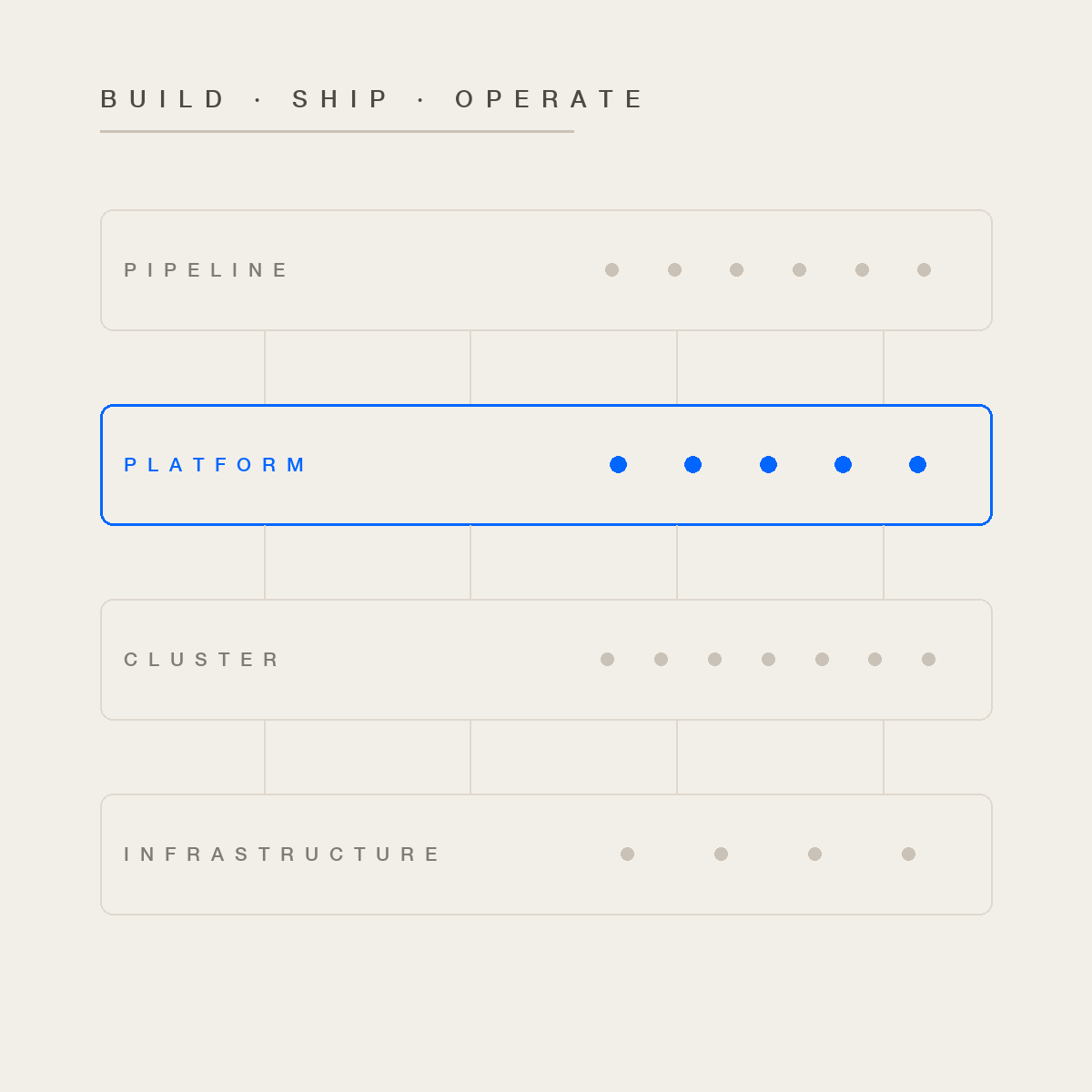
We run cloud and delivery engineering for institutions that have to stay in control of where workloads sit and what they cost. The centre of gravity is public cloud — AWS and Azure — together with the automation that keeps change fast, repeatable and auditable. Where residency or sovereignty obligations apply, that extends to hybrid and on-premises designs.
Our cloud expertise is concentrated on AWS and Azure: landing zones and account structure, migration planning and execution, hybrid connectivity back to on-premises systems, identity integration, and the guardrails that keep an estate compliant as it grows.
We work to the constraints first — what may leave the Kingdom, what must stay, and what a regulator will expect to see — and design within them, rather than designing for the cloud and negotiating the constraints afterwards.
Cloud turns infrastructure from a capital purchase into an operating expense, and in doing so moves spending decisions out of procurement and into the hands of every engineer who can provision a resource. That is the point of cloud. It is also the problem: cost accrues continuously, from thousands of small decisions, and almost none of them are visible at the moment they are made.
FinOps is the discipline of putting that back under control without slowing delivery down. It matters because both alternatives are worse — either spend grows unchecked until finance imposes a freeze that stalls engineering, or teams over-correct and starve the business of capacity. Done properly, it answers three questions continuously: what are we spending, who is spending it, and is it buying anything.
In practice that means tagging and allocation so cost maps to teams and services instead of arriving as one undifferentiated bill; rightsizing and commitment planning so you pay for what you actually use; showback or chargeback so the people making the decisions see the consequences of them; and forecasting accurate enough to plan against.
We deliver this work with CloudScore, whose platform provides the visibility and accountability layer the discipline depends on — spend broken down by team, service and environment, anomalies surfaced early, and reduction tracked over time rather than claimed once.
Running AI inside your own perimeter is an infrastructure problem before it is a model problem. We build the GPU environments and enterprise AI platforms that make on-prem AI practical — capacity that can be scheduled, shared and governed across teams.
AWS and Azure as primary cloud platforms. CloudScore for FinOps. Grafana for observability, so infrastructure health, application performance and user experience are visible in one place. Beyond those, platform choices follow the estate — we work with what a client already runs wherever replacing it would cost more than it returns.
Cloud designs are built against SAMA's cloud computing framework and NDMO expectations on residency and classification, with data location, access and audit decided at design time rather than discovered during review.

Cloud cost optimisation and FinOps.
Our FinOps engagements run with CloudScore — giving clients visibility, accountability and measurable control over cloud spend.
Visit site ↗
Observability, dashboards and monitoring.
We build observability stacks on Grafana so infrastructure health, application performance and user experience are visible in one place.
Visit site ↗